
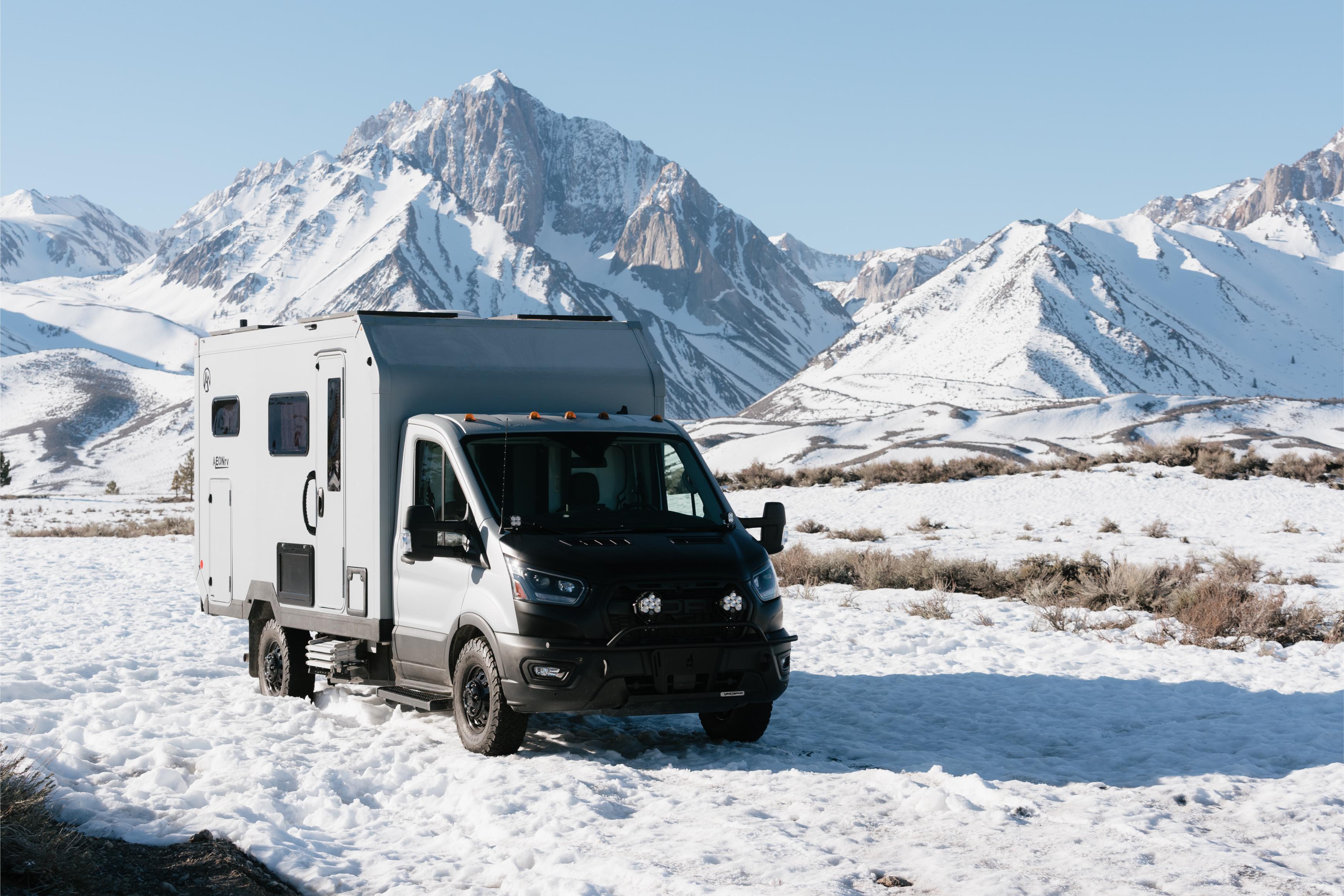
AEONrv is built to give people the freedom to explore. Before we committed to a chassis, we evaluated the two leading commercial cutaway platforms for an all-season, off-road, electric cabin RV. The Ford Transit AWD Cutaway won the decision, and the gap was not close.
Here is the feature-by-feature breakdown of why we chose the Ford Transit AWD Cutaway over the Mercedes-Benz Sprinter Cutaway for every AEONrv we build.
Ford Transit vs Mercedes Sprinter: Side-by-Side Comparison
Drivetrain: More Traction, More Control
The Transit uses Ford Intelligent full-time AWD with five selectable drive modes: Normal, Slippery, Mud/Rut, Eco, and Tow/Haul. The system reads conditions and delivers torque the moment traction is needed, and the driver can tune response for loose gravel, snow, and wet pavement.
The current Sprinter AWD is seamless, but it does not offer driver-selectable terrain modes. For AEONrv owners heading into mixed backcountry conditions, that matters.
The 10-speed automatic with SelectShift backs up the AWD system. Extra gears keep the EcoBoost engine in its power band on long mountain climbs and under tow. The Sprinter 9G-TRONIC 9-speed is capable, but it is a less refined match for varied off-road loads.
Power: 47 Percent More Horsepower, 20 Percent More Torque
The Transit ships with a 3.5L EcoBoost twin-turbo V6 gasoline engine producing 310 hp and 400 lb-ft of torque. That is confident acceleration fully loaded, even at altitude.
The Sprinter Cutaway runs a 2.0L high-output diesel with 211 hp and 332 lb-ft. The EcoBoost delivers roughly 47 percent more horsepower and 20 percent more torque, which shows up every time AEONrv climbs a pass or pulls into a high-elevation trailhead.
Fuel Strategy: Gasoline Wins on Remote Routes
The Transit runs on 87 octane gasoline, available at every station on the way to any trailhead. The Sprinter runs on ultra-low-sulfur diesel plus DEF, with fewer stations on remote routes and another fluid to manage.
Diesel is more efficient on paper. The Sprinter averages about 18 to 22 MPG and the Transit averages about 14 to 17 MPG. Lower gasoline prices and no DEF cost offset the MPG difference across total fuel spend, and the Transit wins on station availability where AEONrv customers actually travel.
Chassis: The Right GVWR and a Factory SRW AWD Option
Both platforms are commercial cutaways with strong payload headroom. Transit GVWR runs from 9,150 to 11,000 lb. Sprinter GVWR runs from 9,050 to 12,125 lb. Either supports the AEONrv build, but the upfit ecosystem we rely on is more developed on the Transit side.
The bigger chassis story is single rear wheel. The Transit 350 is factory-rated for single rear wheel AWD in 138 and 156 inch wheelbases and is fully NHTSA compliant from the factory. The Sprinter Cutaway ships with dual rear wheels, and single-wheel setups are aftermarket conversions that carry certification caveats. SRW matters for tight forest roads, narrow trailhead parking, and overall off-pavement geometry.
Ground Clearance: We Engineer Our Own
Stock Transit clearance is 5.2 to 5.7 inches. Stock Sprinter clearance is approximately 8.0 inches. AEONrv closes and exceeds that gap with a 2 inch lift, BFGoodrich KO3 all-terrain tires, and underbody skid protection. The finished AEONrv reaches trailheads most RVs avoid, while matching AEONrv ride quality on a Sprinter would require additional suspension work.
DEF and Limp Mode: A Risk We Engineered Out
Sprinter diesels have well-documented DEF injector, heater, and sensor faults that trigger limp mode, particularly in cold weather. For an all-season RV expected to start and run in deep winter conditions, that is a serviceability risk we refused to pass to our customers.
The Transit gas V6 has no DEF system, so there are no DEF-related limp-mode failures in the field. Simpler, more predictable, and easier to recover from if something does go wrong.
Service Network: About 3,000 Ford Dealers, Nationwide
Freedom to explore means freedom to get back. Ford operates approximately 3,000 US dealers, including Commercial Vehicle Centers in every major market. Parts are widely available and labor rates are competitive. Sprinter service is a smaller network of qualified specialists, concentrated in metro areas, with premium parts and specialist labor.
If something needs attention during a ski trip in Montana or an overland loop through Utah, a Ford service bay is usually within a short drive. That is a meaningful ownership advantage on a vehicle designed for remote travel.
5-Year Total Cost of Ownership
Over the first 100,000 miles, the Transit lower fuel, service, and parts costs produce a lower cost per mile than the Sprinter. Sprinter resale is stronger and partially offsets the higher operating cost, but it does not close the gap. For AEONrv owners, that shows up as a better acquisition price and lower year-over-year ownership cost.
The Bottom Line
The Ford Transit AWD Cutaway aligns with AEONrv criteria on drivetrain control, power, factory SRW AWD availability, service network, and 5-year cost of ownership. The Sprinter Cutaway is a capable commercial platform, and we respect it, but it did not match our criteria for this build.
That is why every AEONrv starts with a Transit. The platform is part of the reason you can explore with freedom.
See the full Ford Transit vs Mercedes Sprinter comparison